Vintage Harley-Davidson T-Shirt Tag Guide: 3D Emblem & Dating

Harley-Davidson has sold rider apparel for more than a century, and the Harley-Davidson Museum dates the company's first-known T-shirt to around 1947. Dating an older Harley tee accurately is not about finding one magic clue. The strongest approach is to compare the copyright or license line, neck and care tags, stitching, country of manufacture and the way the graphic itself was printed.
This guide is built to help you narrow down the era quickly, then cross-check multiple details before calling a shirt vintage or assigning a specific year.
Start With Two Things
Before anything else, check these two. They settle most shirts on their own.
1. The copyright or license line on the print. Check the bottom edge of the front or back graphic for small text such as © H-D, a year, a licensee name or a 3D Emblem credit. This usually dates the artwork or licensed design, not necessarily the exact garment. Use it as an anchor, then confirm it against the tag, stitching, country of manufacture and construction.
2. The sleeve and hem stitching. Turn the sleeve hem inside out. One line of stitching is a useful age clue and is common on many 1970s through early-1990s tees, but it is not proof by itself. Manufacturers transitioned to double stitching at different times during the 1990s, so authentic late-1990s and early-2000s Harley shirts can absolutely be double stitched. Modern reproduction blanks can also imitate single-stitch construction.
The 3D Emblem Clue
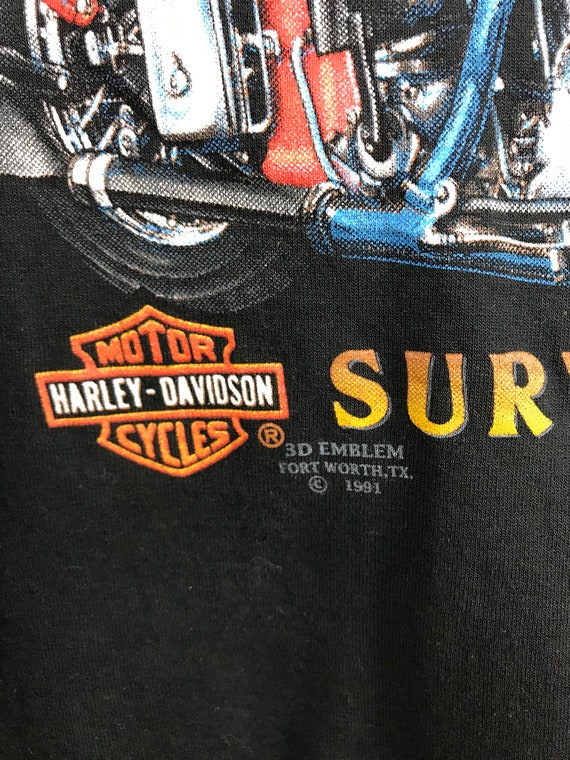
Look closely at the graphic itself, not just the neck label. Many late-1980s and early-1990s Harley tees carry a small printed credit inside or beneath the artwork reading 3D EMBLEM followed by a city and state and a copyright year — for example 3D Emblem, Fort Worth, TX © 1991.
3D Emblem produced a large amount of collectible Harley-Davidson merchandise in this period. A printed credit such as 3D EMBLEM — FORT WORTH, TX. with a copyright year is a strong dating clue, but it is not proof by itself. 3D Emblem graphics are heavily reproduced, so the print credit still needs to agree with the garment's tag, construction, stitching, fabric and natural wear.
1960s and 1970s: Before Harley Had Its Own Tag


There was no standardised Harley neck label in this era. Dealers bought blank shirts and printed them locally, so the tag you find belongs to the blank manufacturer, not to Harley.
- Tags you will see: Hanes, Screen Stars, Champion, Collegiate Pacific, or no tag at all
- Construction: Made in USA, single stitch throughout, noticeably thin and soft cotton
- Graphics: Usually one colour, often just a dealer name and a Bar & Shield
- Sizing: Runs small by modern standards. A 1970s Large often measures closer to a modern Medium
These are genuinely rare. They were work shirts, worn to death, and very few survived in wearable condition.
1980s: Harley Starts Tagging Its Own


This is when Harley-Davidson branded neck labels appear in volume, usually black with the orange and white Bar & Shield. Blank-body shirts with dealer prints still exist alongside them.
- Tags: Harley-branded woven labels appear; Screen Stars, Hanes and Anvil blanks still common
- Construction: Made in USA, single stitch
- Fabric: 50/50 cotton-poly blends become widespread
- Graphics: Big front print with a dealer and city hit on the back. This is the layout collectors chase
- Print credit: 3D Emblem credits start appearing late in the decade
1990s: Peak Harley Merchandise

Woven tags get more polished and start carrying registered trademark marks and licensing text. You will frequently see Harley-Davidson MotorClothes branding in this era.
- Tags: Centred Harley logo, often with ®, sometimes MotorClothes wording
- Construction: Made in USA remains common. Single stitch is widespread, while double-stitch construction also appears depending on manufacturer and becomes more common later in the decade; Mexico and Canada production also appears.
- Fabric: Heavier, pre-shrunk cotton
- Graphics: Eagles, flames, skulls, choppers. Large back prints standard
Rally shirts from Sturgis, Daytona and Laconia are the most collected shirts of this decade, especially with the rally year printed on the graphic. A dated Sturgis Black Hills Rally tee is worth multiples of a plain logo shirt from the same year.
2000s: The End Of Made In USA

US production winds down across the decade and effectively ends around 2010. Tags get busier with care and licensing information, often multilingual.
- Tags: Bar & Shield branding continues, now with more legal text
- Construction: Double stitch standard. Mexico, Honduras, Dominican Republic
- What to look for: A Made in USA tag from this decade is end-of-era and worth more than the same graphic made offshore
2010s To Now: Mixed Labels And Global Production


The important point: modern Harley-Davidson apparel does not use one universal neck-label style. Genuine modern pieces can have either a physical woven/sewn label or a printed tagless neck mark.
- Tags: Modern Harley-Davidson shirts use a mix of woven or sewn-in labels and printed neck information depending on the collection, licensee, dealer program and manufacturer.
- Construction: Double stitching is standard on most modern tees.
- Origin: Modern production is commonly offshore. Countries of origin vary by product and licensee, so origin is supporting evidence rather than a stand-alone date.
- Best dating clue: Treat the neck label as one piece of evidence, not a decade stamp. Cross-check the graphic copyright, RN/licensee, care label, country of manufacture and construction.
Fanatics Era: 2017 And Newer

Where Fanatics fits: treat a Fanatics Licensed Sports Group, LLC label as a strong late-2010s-or-newer clue. Fanatics completed its acquisition of VF Licensed Sports Group on May 1, 2017, and trade reporting at the time confirmed that VF's Harley-Davidson apparel license transferred to Fanatics. Dated Harley examples with Fanatics tags are documented in 2018 and 2019.
Important: a Fanatics tag does not give you the exact production year by itself. Use the printed copyright date, dealer or rally year, style code, care label and country of manufacture to narrow it further. It is best thought of as a 2017+ era marker, not a one-year date stamp.
The Licensee Decoder
Harley-Davidson apparel has been produced through its MotorClothes programs as well as by licensed manufacturers and distributors. That makes the company name, licensee and RN number useful supporting evidence when dating a garment. An RN identifies the business responsible for manufacturing, importing, distributing or selling the textile product; it does not by itself tell you the production year.
- 3D Emblem — late 1980s into the 1990s. Credit printed on the graphic, often with a city and year
- Holoubek Inc. — Wisconsin. The classic Made in USA era shirts
- De-lux Merchandise, RN 88389 — mid 2000s. We have a dated 2006 example carrying this tag
- R.K. Stratman Inc., St. Louis MO — mid 2000s through the late 2010s. Our dated 2016 piece carries it
- Bravado International Group, RN 102050 — around 2018 to 2021. Our dated 2020 piece carries it
- Fanatics Licensed Sports Group — 2017 onward is the safe dating window. Fanatics acquired VF Licensed Sports Group in 2017 and inherited the Harley-Davidson apparel license. A Fanatics label is a strong modern-era clue, but use the graphic date, style code and care tag to narrow the exact year.
An RN number is a Registered Identification Number issued by the US Federal Trade Commission. It identifies the company responsible for the garment, and you can look any of them up in the FTC's public RN database for free.
Dealer And Rally Tees
Dealer tees carry a city and state on the back — Fort Worth, Daytona Beach, Tomahawk. They are worth more than plain logo tees because they are regional, printed in smaller runs, and collected by location.
Two things raise the value further: a dealership that has since closed, and a rally or anniversary year printed alongside the city. Sturgis is the most collected rally name, and a shirt with the year on the front is a dated artifact rather than a generic graphic.
Red Flags
A modern shirt pretending to be old usually gives itself away in one of these ways:
- Tagless printed neck label with a 1970s-looking graphic
- Even, uniform distressing across the whole print. Real wear cracks where the shirt folds and rubs
- A construction method, tag or country of manufacture that conflicts with the claimed era
- Garment-dyed heather colours that did not exist on Harley blanks in the claimed era
- A perfect graphic on a soft, thin, obviously old body — prints age with the shirt
- Flat, printed-on 3D Emblem styling with no raised texture
Quick Reference
3D Emblem credit with a printed year — strong dating clue; confirm against tag and construction
Single stitch + Made in USA + period-correct tag — strong vintage signal, but still cross-check the print and copyright
Single stitch + Made in USA + no date — worth a closer look; do not assign a year from stitching alone
Double stitch + Made in USA — commonly seen from the 1990s into the 2000s depending on manufacturer
Double stitch + offshore + woven tag — commonly 2000s to 2010s, but verify the label and graphic
Tagless printed neck — generally modern production and not a feature of true early-vintage Harley tees
Frequently Asked Questions
How can I tell what year my Harley-Davidson shirt is?
Start with any copyright or license line printed on the graphic, then compare it with the neck tag, care tag, stitching and country of manufacture. No single clue should be used in isolation.
What does 3D Emblem mean on a Harley shirt?
3D Emblem was a major producer of collectible Harley-Davidson graphics. Period shirts often show a printed 3D Emblem credit with Fort Worth, Texas and a copyright year. Because these designs are reproduced, confirm the credit against the rest of the garment.
Does single stitch mean a Harley shirt is vintage?
No. Single stitching is a useful clue on older shirts, but modern reproduction blanks can use it too. Tag style, print details, fabric and country of manufacture matter just as much.
Can a double-stitch Harley shirt still be vintage?
Yes. Double stitching appears on authentic Harley shirts from the 1990s onward, and many early-2000s shirts now meet the common 20-plus-year vintage definition.
Does the copyright year equal the year the shirt was made?
Not necessarily. The date generally refers to the artwork or licensed design. The garment itself may have been produced later, so always cross-check the other clues.
What makes a vintage Harley-Davidson shirt valuable?
Age helps, but value also depends on the graphic, dealer or rally location, 3D Emblem association, rarity, size, condition and collector demand.
Sources & Reference Images
This guide cross-checks examples against public vintage listings and historical/reference material. Useful references include the Harley-Davidson historical archive, the FTC RN database, and the Vintage Rare USA Harley tag guide. Third-party reference images remain the property of their respective owners.
Shop And Sell
Browse our current Harley-Davidson shirts — dealer tees, rally merch, tanks and jackets, every piece photographed and measured individually.
Sitting on a Harley collection? Sell us your tees. Photograph the front, the back and the neck tag. The tag is the photo that matters most.